Kavya Wadhwa

About Kavya

Kavya Wadhwa is a globally engaged Nuclear Policy Advocate and Policy Analyst with robust expertise at the intersection of nuclear technology, security, and international policy. Blending rigorous academic training in nuclear physics with practical experience in diplomacy, research, and advocacy, Kavya serves as a dynamic voice shaping the future of nuclear discourse.

  • Age21
  • ResidenceINDIA
  • E-mailkavyavadhwa@gmail.com

 Currently contributing to global nuclear governance as a Deputy Research Lead for Nuclear4Climate at COP30 (UNFCCC) and an active delegate to COP29 Azerbaijan, Kavya is deeply involved in drafting international position papers, advising multilateral stakeholders, and fostering public awareness on the role of nuclear energy in combating climate change. 

Kavya’s expertise includes, Nuclear Reactor Technology, nuclear weapons policy, nonproliferation frameworks, arms control, and nuclear energy regulation. His work addresses emerging threats from advanced nuclear technologies, geopolitical instability, and the breakdown of traditional arms control treaties, offering strategic insights to government bodies, research institutions, and international forums.

With a foundation in Bachelor of Science in Physics from Pandit Deendayal Energy University, Kavya’s academic journey includes advanced training at prestigious institutions such as MIT (22.011x: Nuclear Energy: Science, Systems, and Society), the University of Geneva (Particle Physics), and UC Berkeley’s REYES program for young scientists. His research focuses on reactor physics modeling, neutronics simulations, and radiation transport analysis, targeting the optimization of reactor safety and design.

Kavya has worked on passive safety systems for Indian Pressurised Heavy Water Reactors, and employed computational techniques to simulate nuclear and particle phenomena. This technical proficiency enhances his credibility in policy arenas, allowing him to critically evaluate and propose evidence-based nuclear governance frameworks.

Through his technical training and policy acumen, Kavya bridges the often-siloed worlds of scientific research and policy implementation. His contributions to nuclear risk reduction, export control regimes, and deterrence theory reflect a holistic approach informed by deep technical knowledge and strategic foresight.

Kavya actively engages with multilateral institutions, think tanks, and academic forums, advocating for responsible nuclear stewardship, transparency in nuclear policy, and stronger international norms. Whether advising on nonproliferation strategy, analyzing reactor deployment risks, or contributing to dialogues on nuclear weapons modernization, he remains committed to a future where nuclear technology is governed safely, equitably, and sustainably.

Some of his other work also encompasses CBRN (Chemical, Biological, Radiological, and Nuclear) security, climate-energy nexus, and generative AI’s applications in energy systems modeling.

Kavya Wadhwa is a globally engaged Nuclear Policy Advocate and Policy Analyst with robust expertise at the intersection of nuclear technology, security, and international policy. Blending rigorous academic training in nuclear physics with practical experience in diplomacy, research, and advocacy, Kavya serves as a dynamic voice shaping the future of nuclear discourse.

Resume

Road Map

Nuclear For Climate
2025

Deputy Research Lead

Leading the global research team in drafting position papers and policy briefs that advocate for the integration of nuclear energy within global climate strategies for
COP30. Responsible for conducting and supervising background research to inform
high-level dialogues with heads of state and international organizations, while shaping
public communication strategies that strengthen the visibility of nuclear solutions in
climate discourse. The role involves managing multi-regional research initiatives,
ensuring analytical precision and timely publication, and driving outreach campaigns
that enhance public engagement and support for nuclear energy as a cornerstone of decarbonization.

UNFCCC constituencies
2023-Present

Nuclear energy consultant

Contributed to global youth-led policy discussions on the role of nuclear energy in sustainable energy transitions. Provided inputs on international nuclear energy strategies.

Examined implications for South Asia's long-term energy security and resilience within the context of evolving international climate and technology diplomacy.

TensorField
2024

Consultant

Analyzed closed nuclear fuel cycles, policy frameworks, and business strategies for nuclear sector growth.

Nuclear For Cliamte
2024

Research Analyst on Nuclear policies for COP29,

Contributed to the drafting of research and policy inputs for the Nuclear for Climate position paper at COP29, focusing on the role of nuclear energy in achieving global decarbonization goals. Analyzed national energy transition frameworks, integrated nuclear pathways within the UNFCCC agenda, and collaborated with international experts to align policy recommendations with sustainable development and climate resilience objectives.

Research

Consultancy

China’s Civil Nuclear Program, Military-Defense Supply Chain, and Security Posture in the Indian Ocean

Conducted an in-depth analytical study examining the intersection of China’s civil nuclear expansion, military-industrial supply chain, and strategic footprint in the Indian Ocean Region (IOR). Assessed reactor export strategies, dual-use technology linkages, and implications for India’s maritime and energy security.

The project integrated open-source intelligence (OSINT), satellite imagery interpretation, and nuclear policy analytics to forecast regional security trends and supply chain dependencies.

Presented at 4th Joint ICTP-IAEA Workshop on Physics and Technology of Innovative Nuclear Energy Systems| International Centre for Theoretical Physics ICTP

Evaluating Reprocessing Techniques and Proliferation Risks in the Management of Advanced Nuclear Fuels,

This research explores reprocessing technologies, such as PUREX and pyroprocessing, used in advanced Generation IV (Gen4) nuclear reactors. It focuses on fuels like TRISO, HEU, HALEU, LEU, and ANEEL, analyzing reprocessing outcomes and associated proliferation risks. The study examines the chemical and physical properties of spent fuels, the effectiveness of reprocessing techniques, and strategies to minimize proliferation risks. By comparing fuel types and reprocessing methods, it highlights the trade-offs between fuel efficiency, waste reduction, and non- proliferation. This work provides critical insights for the design, policy, and future sustainability of nuclear energy.

Optimizing Heat Recovery from Nuclear Reactors for Energy Storage

Conducted an in-depth study on integrating sand-based thermal energy storage (TES) systems with nuclear power plants to enhance waste heat utilization and improve overall efficiency. Analyzed the thermodynamic and material properties of sand as a high-temperature storage medium, evaluating its feasibility for long-duration energy storage.


Explored the potential of TES in enabling load following capabilities, cogeneration applications, and decarbonizing industrial sectors by  supplying stored heat for off-grid energy needs.

Proposed innovative system designs to maximize heat recovery, improve reactor efficiency, and contribute to a more resilient and sustainable nuclear energy infrastructure

Overview of Israel's Nuclear Weapon Program, (Interdiciplinary)

Conducted independent research analyzing the development and evolution of Israel's nuclear program, focusing on the Dimona nuclear facility, nuclear weapons production, and integration with the country's defense sector.

Explored Israel's clandestine nuclear capabilities, strategic partnerships, and advanced weapon delivery systems, including the Jericho missile series and Dolphin class submarines. The research provides insights into Israel's nuclear deterrence strategy and its geopolitical significance.

Portfolio

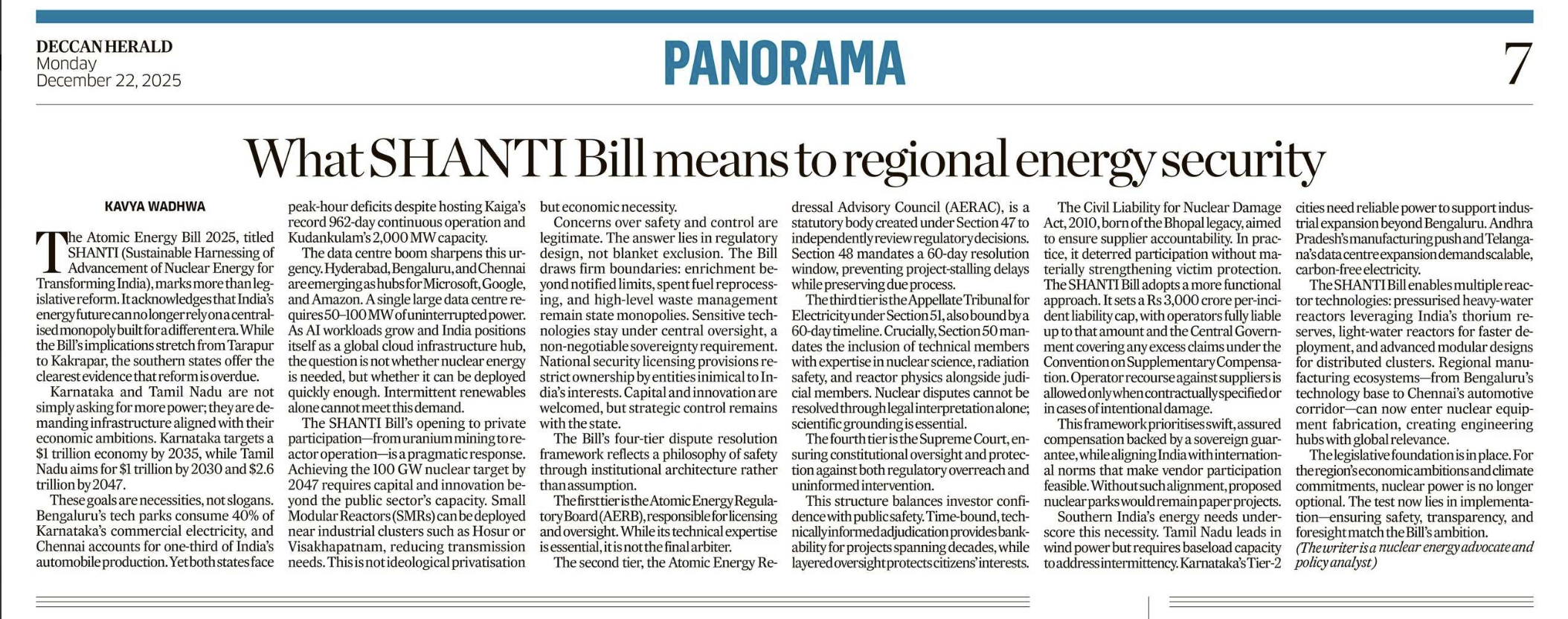
India’s push to join the nuclear power club

India’s push to join the nuclear power club

Media Feature
India’s Nuclear Leap: Balancing Vision and Roadblocks

India’s Nuclear Leap: Balancing Vision and Roadblocks

Detailed
Nuclear Security at Risk: Quantum Computing’s Silent Attack

Nuclear Security at Risk: Quantum Computing’s Silent Attack

Detailed
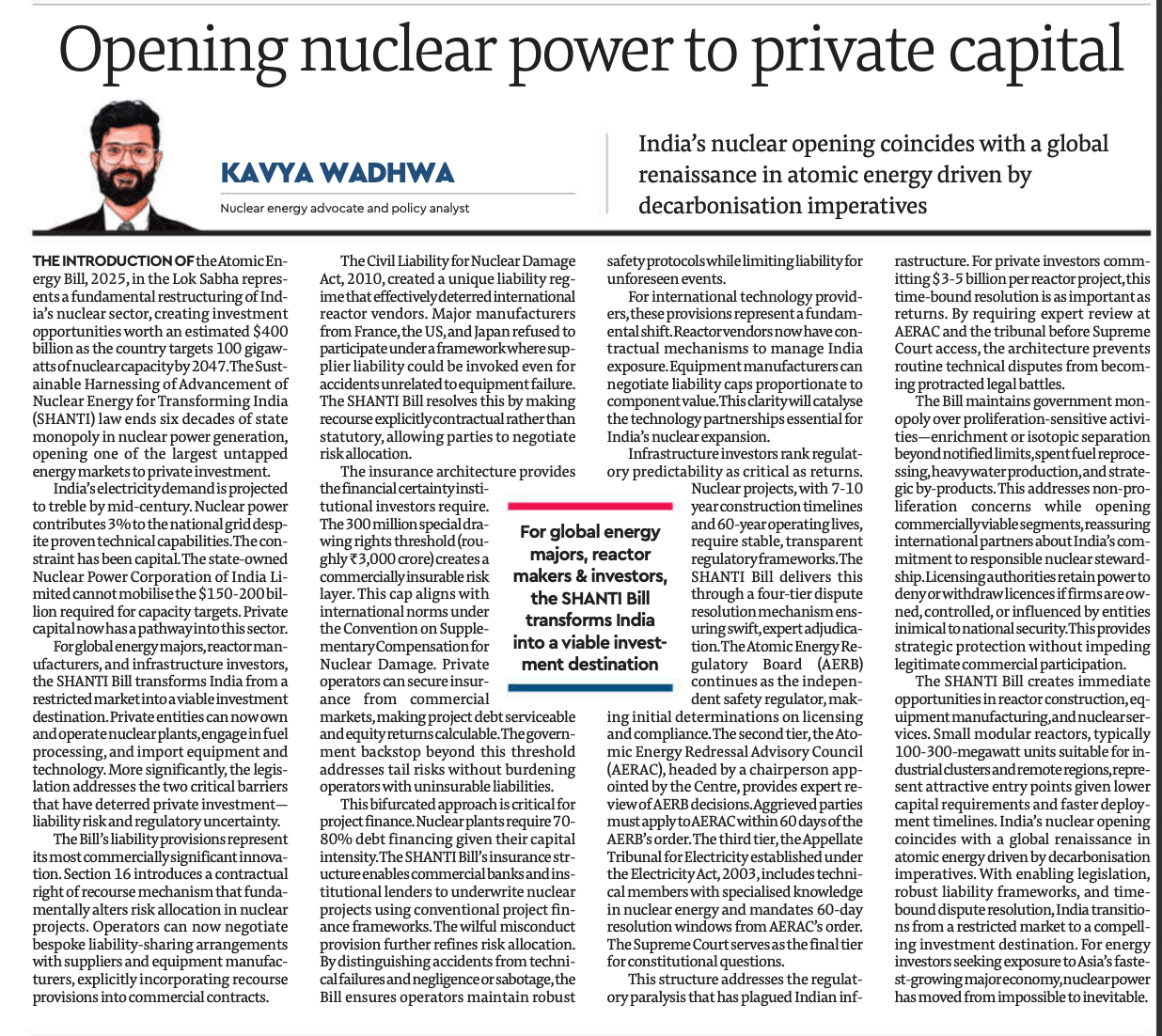
Public-private partnerships and the Indian nuclear frontier: A new era of energy security

Public-private partnerships and the Indian nuclear frontier: A new era of energy security

Detailed

Contact

India

+91 9098599959

kavyavadhwa@gmail.com

Freelance Available

How Can I Help You?